5 tips for managing your personal tax as a business owner
Category: Private Clients Posted on: October 19, 2026Running a successful business can be incredibly rewarding, but ensuring your hard-earned profits translate into personal wealth can be challenging.
Indeed, this exercise requires careful, ongoing planning, and some entrepreneurs spend so much time managing their firm’s operational cash flow that they overlook their personal tax position.
This could leave money on the table and see you paying more tax than necessary.
Fortunately, you have plenty of options to work with, from optimising your salary levels to utilising tax-efficient investment wrappers. Here are five practical strategies you could adopt to help manage your tax liability.
1. Mind the Income Tax thresholds when setting your director’s salary
As the owner of a business, paying yourself a modest salary combined with dividends is often key to tapping into your company’s profits. However, setting the right salary for yourself requires balancing several key factors, including maintaining qualifying National Insurance contributions (NICs) to help build your record for the full State Pension without triggering unnecessary personal tax.
It’s important to remain mindful of higher income thresholds, as they could push you into higher tax brackets and eat into your cash flow.
As of the 2026/27 tax year, Income Tax rates and bands are as follows:
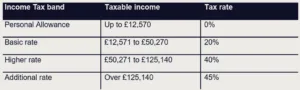
Please note: Scotland has different Income Tax thresholds and rates, which could affect your personal tax liability.
Once your total taxable income exceeds £100,000, your Personal Allowance tapers away by £1 for every £2 earned above this threshold. This creates an effective marginal tax rate of 60% on income between £100,000 and £125,140.
While taking a salary up to the Personal Allowance may be tax-efficient, keep in mind that the employer Secondary Threshold for National Insurance sits at £5,000. So, unless your business qualifies for the Employment Allowance, salaries above £5,000 will trigger employer NICs.
Tax rules and exemptions can be complex, so it’s important to be mindful of how your personal circumstances might affect your liability. A financial planner could help you assess your options.
2. Consider whether taking dividends is an appropriate addition to your salary
Dividends offer a flexible way of extracting profits because they are not subject to employee or employer NICs. However, dividends can only be distributed from profits retained after Corporation Tax has been deducted.
The UK government grants each taxpayer a £500 tax-free Dividend Allowance. Dividend income above this threshold is then taxed at rates determined by your overall Income Tax band. These are the rates as of the 2026/27 tax year.
- Basic rate band: 10.75%
- Higher rate band: 35.75%
- Additional rate band: 39.35%
For UK limited company directors, a combination of salary and dividends may be more tax-efficient than taking all of your income as either one alone.
3. Make the most of employer pension contributions to lower your tax liability
Overlooking your pension could be a significant mistake, yet many business owners miss out on the opportunity. In fact, according to data reported by Pensions Age (18 February 2026), 50% of self-employed workers made no monthly contributions to a pension or retirement fund.
Whether your long-term plan is to sell your business or build independent wealth elsewhere, paying into a pension delivers dual benefits: building a reliable retirement safety net while reducing your overall tax burden.
Instead of making personal pension contributions from your taxed income, your limited company can make direct employer pension contributions on your behalf.
Because these are usually treated as an allowable business expense, this also reduces your business’s Corporation Tax liability.
Under the standard Annual Allowance, you can contribute up to £60,000 per tax year into registered pension schemes. However, you can only claim tax relief up to 100% of your annual earnings. You may also carry forward unused allowances from the previous three tax years. High earners bringing home more than £200,000 should note that a tapered Annual Allowance may apply. If you have already accessed your pension flexibly, you could be subject to a lower Annual Allowance.
Remember that your pension contributions will usually be invested and not normally accessible until 55 (57 from April 2028), and that returns cannot be guaranteed. Investment values may fall as well as rise, and you may not get back the full amount you invested.
4. Use tax-efficient investment wrappers to protect non-business growth
Pulling wealth from your business is one part of the equation. It’s just as important to consider where you hold those assets. Remember, holding excess capital in standard taxable bank accounts or General Investment Accounts could expose your returns to Dividend Tax, Capital Gains Tax (CGT), and Income Tax.
Maximising your annual ISA allowance enables you to save or invest up to £20,000 each tax year free from Income Tax and CGT.
Keep in mind that from April 2027, ISA rules are changing. A Cash ISA limit of £12,000 will be introduced for savers under age 65.
The total annual ISA limit will remain at £20,000, which aims to encourage further investment in Stocks and Shares ISAs.
5. Be sure to claim all allowable business expenses to reduce taxable profit
Claiming all legitimate business expenses can reduce your company’s net profit, which lowers Corporation Tax and preserves more funds within the business for future investment or distribution.
Allowable expenses must be incurred “wholly and exclusively” for business purposes. Common expenses that you may be forgetting to claim fully include:
- Working from home allowance. You can claim the flat HMRC rate or calculate a percentage share of household utility bills.
- Business travel and mileage. You can claim up to 55p per mile for the first 10,000 business miles (and 25p thereafter) when using a personal vehicle depending on type of engine. The rate may be lower if you have an electric vehicle.
- Professional subscriptions and training. Industry body memberships, relevant professional publications, and training directly related to your business operations all count as allowable expenses.
Ensure you maintain clear digital records, receipts, and invoices as part of your system. This provides a transparent paper trail for HMRC and keeps your business secure and compliant.
Take your next steps towards tax-efficient business management
Managing your personal tax position alongside running a successful business requires balance, foresight, and specialist knowledge.
Whether you would like to optimise your profit extraction strategy, structure your pension contributions, or protect your wealth, we’re here to help.
Please note: This article is for general information only and does not constitute advice. The information is aimed at individuals only.
All information is correct at the time of writing and is subject to change in the future.
The Financial Conduct Authority does not regulate tax planning. Levels, bases of and reliefs from taxation may be subject to change and their value depends on the individual circumstances of the investor.
By us, for you
Delve into our collection of articles, containing useful guidance and ideas to help you plan, save, and make the most of your money.

5 potential red flags that could signal a scam that you shouldn’t ignore
Private Clients Read further




Why viewing your lifestyle goals as an experiment could lead to success
Private Clients Read further


6 useful tips for avoiding headline-driven decisions ahead of the Budget
Private Clients Read further
Are you supporting adult children? Here’s why it should be part of your financial plan
Private Clients Read further